
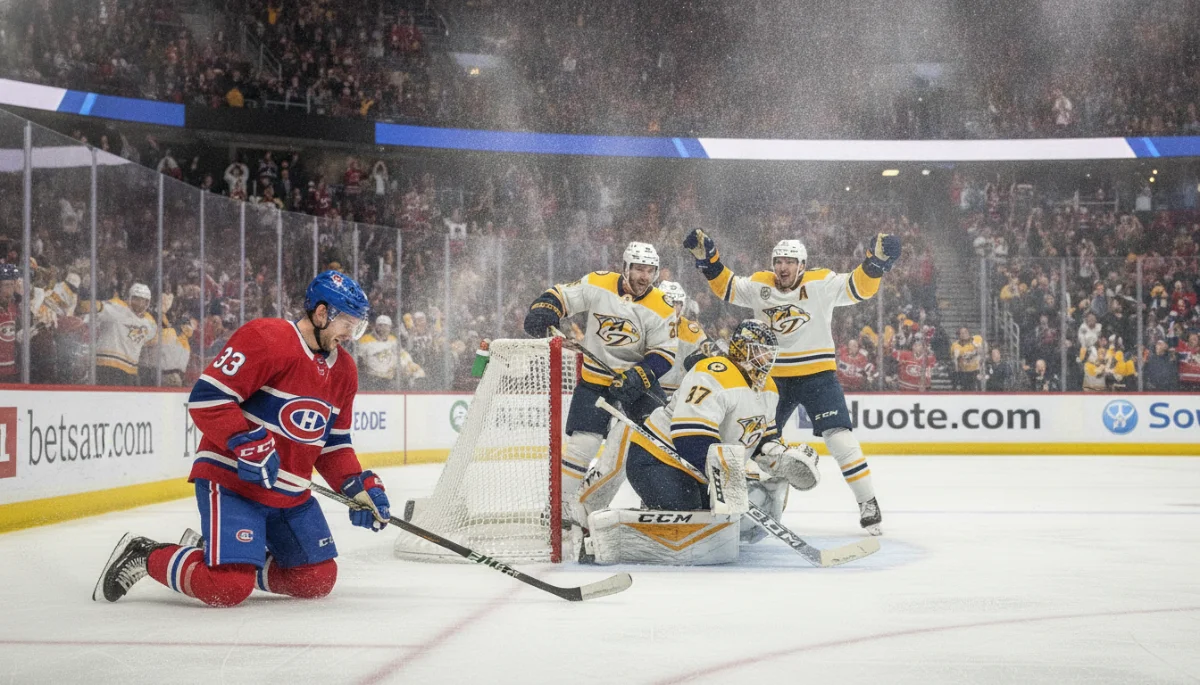
Montreal appeared to have Nashville under control Thursday night, but a promising performance unraveled into a 5-2 loss at the Bell Centre. The Canadiens seized a 2-0 advantage, created more pressure for long stretches and looked like the stronger team before the Predators scored five consecutive goals.
Ryan O’Reilly’s power-play deflection with 3:16 left in regulation completed Nashville’s comeback. Two late empty-net goals from Adam Edstrom made the final margin look decisive, even though the game remained close until the closing minutes.
The defeat extended Montreal’s winless run to three games and left the Canadiens at 1-2-1. More frustrating than the result was the way the opportunity disappeared: Montreal needed better finishing, cleaner discipline and stronger execution in the most important moments.
A Two-Goal Lead Became a Missed Opportunity
The Canadiens did not begin the night as an overwhelmed team. They spent extended stretches attacking in Nashville’s zone and generated enough offensive momentum to build a substantial lead.
Nick Suzuki opened the scoring during four-on-four play, finding room near the crease and beating Juuse Saros with a backhand shot. The captain’s third goal of the young season gave Montreal the reward it had earned through sustained pressure.
Alex Newhook added another goal at 8:50 of the second period. Josh Anderson created the chance with a strong feed after the Canadiens had kept the Predators pinned in their own end.
At 2-0, Montreal had the game positioned exactly where it wanted it. The crowd was engaged, Nashville was struggling to create consistent offense and the Canadiens seemed capable of pulling away.
That third goal never arrived. Montreal continued to produce chances, but Saros repeatedly denied the hosts. His performance kept the Predators close enough to believe a comeback remained possible.
Saros Protected Nashville Until Its Offense Arrived
Juuse Saros was the central reason Montreal could not turn its early advantage into a knockout blow. The Nashville goaltender stopped 32 of 34 shots and made several saves during sequences when the Canadiens appeared ready to extend their lead.
His most important stop came late in the third period. Josh Anderson broke in alone with roughly eight minutes remaining, offering Montreal a chance to move ahead 3-2 and reclaim control of the game.
Saros stayed with the play and turned the attempt aside with his left pad. That save preserved the tie and gave Nashville an opportunity to shift the momentum once again.
The difference between the teams was not simply the number of chances each created. Montreal had opportunities but did not finish them. Nashville had fewer openings, yet converted when the game presented its biggest moments.
That distinction matters for a young team. Possession and territorial control can establish an advantage, but neither guarantees points. Montreal needed to make its strong stretches count on the scoreboard.
Late-Period Mistakes Changed the Entire Game
Nashville’s comeback began near the end of the second period. Alex Kerfoot redirected a shot with 4:54 remaining, cutting Montreal’s lead to 2-1 and giving the Predators the spark they had been missing.
The Canadiens then allowed the equalizer at an especially damaging time. Matthew Wood scored on the power play with only 32 seconds left in the period, sending both teams into the intermission tied at 2-2.
The timing turned a comfortable Montreal lead into a completely different game. Instead of carrying confidence into the third, the Canadiens had to regroup while Nashville entered the final period with renewed belief.
Momentum in the NHL can change quickly, but goals at the end of periods often carry extra weight. They alter the emotional tone of the locker rooms and give the scoring team a chance to dictate the opening minutes that follow.
Montreal’s problem was not only that Nashville scored twice. The Canadiens also failed to respond with the same urgency after the game became even.
Special Teams Put the Predators Ahead
Penalties became decisive once the score tightened. Nashville scored twice on the power play, including the goal that tied the game and the marker that gave the Predators their first lead.
With the game still tied late in the third, Mike Matheson was penalized for tripping Steven Stamkos. Montreal could ill afford to hand Nashville another advantage after spending much of the night unable to create separation.
O’Reilly made the Canadiens pay. Roman Josi’s point shot reached the net, and O’Reilly redirected it past Jacob Fowler with 3:16 remaining. The deflection gave Nashville a 3-2 lead and completed the most important reversal of the night.
Montreal’s power play did not provide an equal answer. The Canadiens received three opportunities but could not generate the same level of impact that Nashville found with the man advantage.
In a one-goal game, special teams can outweigh extended five-on-five stretches. Montreal’s penalty trouble and ineffective power play combined to create a major disadvantage when the margin for error was smallest.
Fowler Faced a Difficult First Start
Jacob Fowler’s first start of the season came under unusual circumstances. Samuel Montembeault left Wednesday’s practice with an apparent lower-body injury, prompting Montreal to recall Fowler from the Laval Rocket.
The 21-year-old stopped 15 shots against Nashville. The final score may suggest a difficult night in net, but two of the Predators’ five goals came after Montreal pulled Fowler for an extra attacker.
Fowler therefore surrendered three goals while playing in the crease. The winning goal was also a difficult one to prevent, as O’Reilly redirected Josi’s shot on the power play.
That does not mean Fowler was flawless. He will likely want certain plays back, as any goaltender does after a loss. Still, the broader causes of Montreal’s defeat were missed chances, penalties and an inability to protect a late tie.
Fowler has previous NHL experience. He appeared in 17 games last season, recording a 9-6-2 record, a 2.43 goals-against average and a .908 save percentage. If Montembeault remains unavailable, Fowler may have to take on a larger role sooner than expected.
The Result Looks Worse Than Montreal’s Overall Play
Edstrom’s two empty-net goals transformed a narrow defeat into a 5-2 score. Those markers should be considered when evaluating the Canadiens’ performance, because Montreal was not three goals inferior during ordinary five-on-five play.
The Canadiens controlled substantial portions of the game and held the early territorial advantage. Their failure was centered on execution rather than a complete lack of structure or effort.
That does not make the loss harmless. Teams trying to move forward must learn to close games when they have a two-goal lead. Montreal had enough chances to create separation and enough time to protect its advantage, but Nashville repeatedly received opportunities to stay alive.
The game also showed how costly a single missed chance can become. Anderson’s breakaway could have restored Montreal’s lead. Instead, Saros stopped it, Nashville earned a power play and O’Reilly produced the decisive deflection.
One sequence does not explain everything, but that sequence captured the night perfectly: Montreal had the chance to seize control, while Nashville finished its opportunity.
Three Immediate Priorities Before Detroit
The Canadiens will host the Detroit Red Wings at the Bell Centre on Saturday, giving them a quick chance to respond. The next game should reveal whether Thursday’s problems were temporary mistakes or signs of a larger pattern.
- Convert pressure into insurance goals. Montreal cannot rely on one or two goals after dominating long stretches. A 2-0 lead provides a foundation, but another goal would have forced Nashville to take greater risks and reduced the importance of one late bounce.
- Defend without taking avoidable penalties. Nashville’s tying and winning goals both came on the power play. Montreal must make disciplined decisions when the game is close, especially late in a period or during the final minutes of regulation.
- Support whoever starts in net. Whether Fowler receives another assignment or Montreal turns to a different option, the skaters must reduce traffic, manage rebounds and limit penalty-killing situations. The uncertainty surrounding Montembeault makes defensive reliability even more important.
- Use the captain’s example around the net. Suzuki’s opening goal came from aggressive positioning near the crease. Montreal needs more direct attacks of that kind instead of relying solely on perimeter possession and extended puck movement.
What the Canadiens Can Take From the Loss
Montreal is not facing a crisis at 1-2-1, particularly this early in the season. However, the record reflects a team that has not yet learned how to turn competitive play into consistent results.
Thursday’s defeat was painful because the Canadiens had a genuine chance to win. They established a two-goal lead, created more offensive pressure and received a strong performance from their captain. Yet they left the game without a point because Nashville was more effective when the stakes increased.
The lesson is straightforward. Montreal must finish its chances before opponents recover, keep its composure when momentum shifts and treat late-game discipline as a priority.
The Canadiens will not need to dominate every minute against Detroit. They will need to manage the important minutes better than they did against Nashville. Saturday’s matchup offers an immediate test of whether this young group can convert frustration into a more complete performance.