
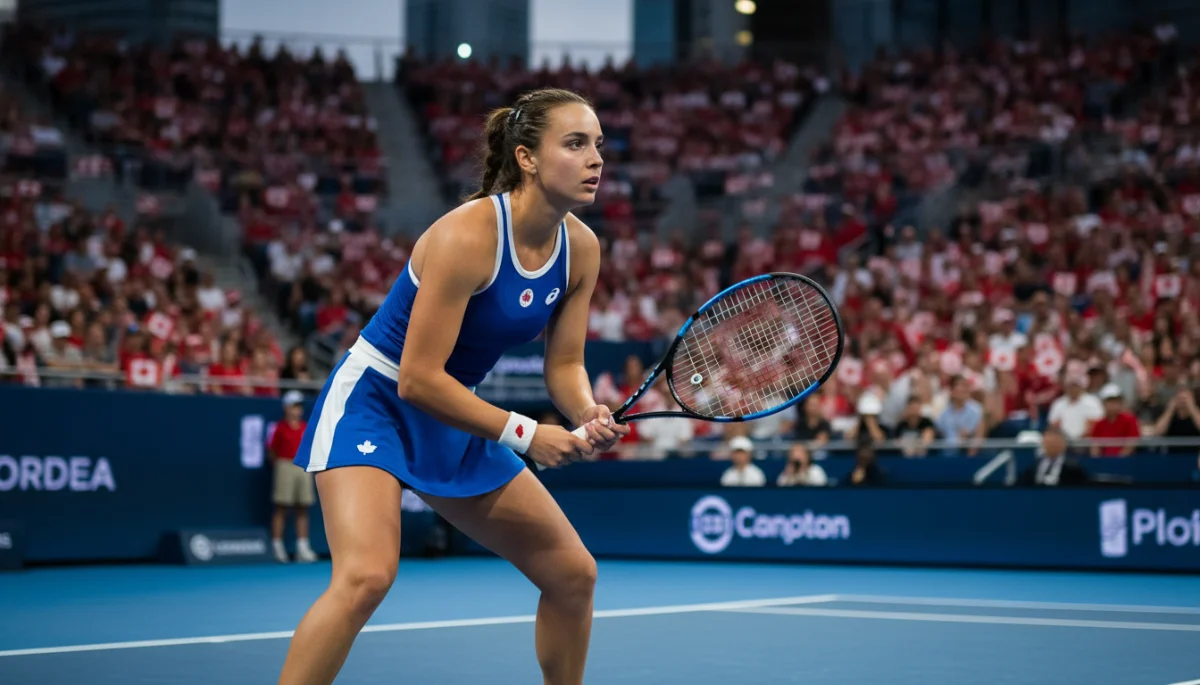
A Big Stage, a Familiar Burden
Leylah Fernandez steps into the National Bank Open with a blend of opportunity and expectation that only a top Canadian player can feel. As the highest-ranked Canadian woman in the field, she is not just playing a second-round match in Toronto; she is carrying the hopes of a crowd that wants to see a deep home-soil run.
Her opponent is Renata Zarazúa of Mexico, and the matchup gives Fernandez a real test right away. Fernandez enters as the No. 30 seed and received a first-round bye, which means she opens her tournament already under pressure to justify both her ranking and the energy surrounding her arrival.
The setting matters almost as much as the scoreline. Toronto fans tend to amplify every momentum swing, and Fernandez has long been one of the players most capable of feeding off that kind of noise. The question is whether the support becomes a lift or a weight once the rallies start stretching and the match becomes tight.
What Toronto Means for Fernandez
Fernandez is no stranger to major attention. Her run to the 2021 US Open final made her a household name in Canadian tennis, and her relentless style has kept her popular ever since. She plays with visible emotion, changes gears quickly, and rarely looks overwhelmed by the moment when she is striking the ball cleanly.
Still, the National Bank Open has not been the event where she has produced her strongest results. This is her seventh appearance, and she has never advanced beyond the third round. Her best showing came in Montreal in 2023, when she defeated then-No. 11 seed Beatriz Haddad Maia before falling in the next round. Entering this year’s event, her career record at the tournament stood at 4-6.
Those numbers create a useful backdrop for this campaign. Fernandez does not lack talent or competitive fire, but this tournament has often asked her to solve a difficult timing problem: how to play freely in front of a supportive home crowd without trying to force a perfect performance.
Recent Form Leaves Room for Optimism and Concern
Fernandez arrives in Toronto after an uneven stretch on hard courts. Her latest result in Washington ended with a second-round loss to Alexandra Eala, a match that slipped away after Fernandez led 5-1 in the second set before losing 6-2, 7-6. Eala later won the tournament, which softens the sting only slightly because the finish still exposed a recurring problem in Fernandez’s season: difficulty closing out matches when the pressure rises.
Her 2026 record before Toronto sat at 12 wins and 19 losses, a line that reflects inconsistency rather than collapse. There have been stronger moments mixed into the struggles, including a quarterfinal run at the Madrid Open, which remains her best result of the year and a reminder that her level can still climb quickly against elite opposition.
When Fernandez is at her best, her left-handed game is aggressive, direct, and disruptive. She takes the ball early, redirects pace well, and can open the court with sharp angles that force opponents into uncomfortable defensive positions. On hard courts, that style can be especially effective if she serves with confidence and keeps her return position high enough to pressure second serves.
Zarazúa Is No Soft Opening Match
The rankings may make Fernandez the favorite, but this is far from a simple opener. Zarazúa is ranked outside the top 70, yet that number does not reflect how awkward she can be as an opponent. She is patient, athletic, and comfortable extending rallies until an opponent takes too much risk.
That style can be especially troublesome for a player like Fernandez, who is often most dangerous when she can dictate quickly and play on instinct. If Fernandez becomes impatient and goes for low-percentage winners too early, she could end up giving away momentum through unforced errors. If Zarazúa manages to turn the contest into a long, physical baseline battle, the match could tighten well beyond what the rankings suggest.
The head-to-head edge belongs to Fernandez, but that advantage will matter only if she starts cleanly. Early rhythm is critical in this sort of matchup. A composed opening set would help her settle into the stadium atmosphere and prevent the crowd’s expectations from turning into tension.
How Far Can She Go?
Fernandez has the talent to produce a strong run in Toronto, but the draw leaves little room for hesitation. A win over Zarazúa would likely send her into a third-round matchup with fifth seed Mirra Andreeva, one of the brightest young players on the WTA Tour and a major step up in quality.
There is also a potential road that includes Elise Mertens and four-time Grand Slam champion Naomi Osaka, which shows how demanding the bracket becomes almost immediately. That kind of path means Fernandez cannot afford to spend too long searching for form. She needs to find her timing now, not after a round or two of wasted chances.
A title run would require her most complete tennis of the season, with cleaner serving, sharper decision-making, and fewer lapses at key moments. Even so, a quarterfinal or fourth-round appearance would already mark a meaningful breakthrough at her home event and provide a strong lift before the US Open. For Fernandez, Toronto is about more than one match. It is a chance to turn home support into real momentum and finally produce the run Canadian fans have waited for.