
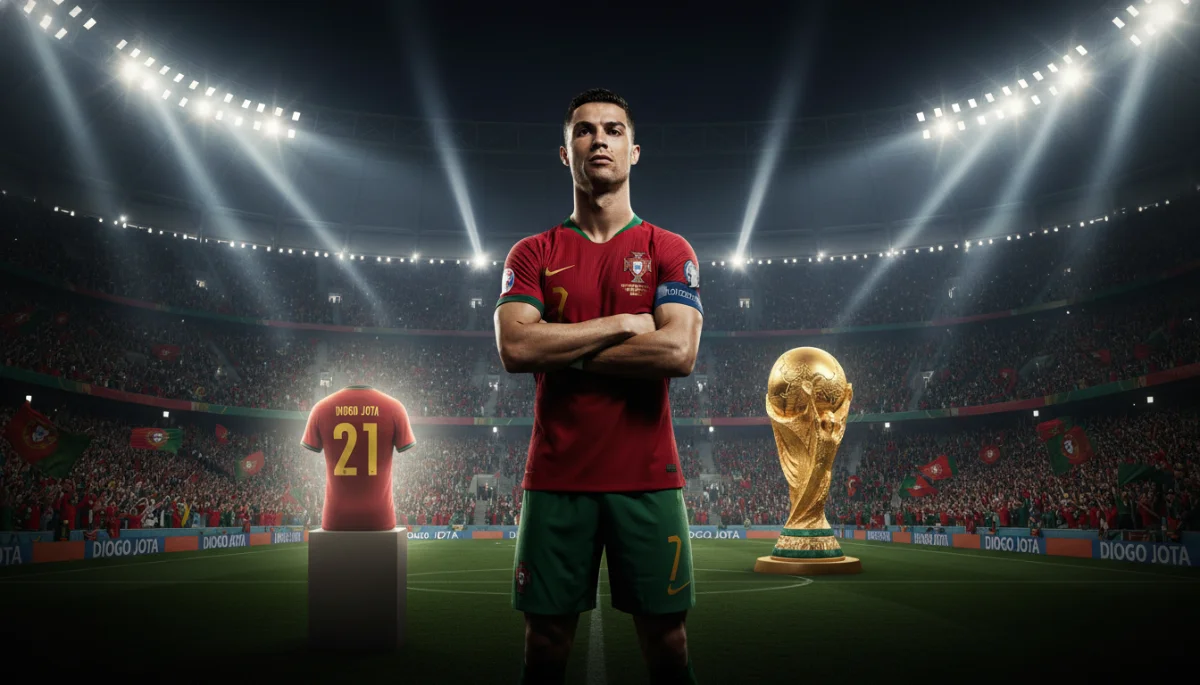
Portugal’s next World Cup chapter arrives with a mix of ambition, emotion, and heavy expectation. Roberto Martínez has revealed a squad built to compete deep into the tournament, and the most recognizable name on the list is still Cristiano Ronaldo. At 41, he is preparing for what could become a record-tying sixth World Cup appearance, a milestone that would underline how long he has remained at the center of the global game.
But this squad announcement was about more than legacy. It also carried a deeply personal tribute to Diogo Jota, whose memory now sits inside Portugal’s journey in a way that goes beyond football. Martínez made clear that Jota will remain part of the team’s story, not as a statistic, but as a presence the group intends to honor throughout the competition.
Ronaldo’s Last Great Chase
For Portugal, Ronaldo’s inclusion is both practical and symbolic. The national team still relies on his experience, his mentality, and his unmatched instinct in decisive moments. He is no longer asked to cover every blade of grass, but he remains the player whose presence changes how opponents prepare and how teammates carry themselves.
If he takes the field at the tournament, Ronaldo will join an extremely small group of men to appear in six different World Cups. That would add another remarkable line to a career already stacked with records. He is already the highest scorer in men’s international football, the leader in men’s international appearances, and the only male player to score in five separate World Cups. Even after all of that, the possibility of one more historic run keeps the spotlight on him.
There is also a broader football context to this milestone. Lionel Messi could reach the same six-tournament mark for Argentina, which means this World Cup may become another stage in the long comparison between two of the sport’s defining figures. For Portugal supporters, though, the focus is simpler: Ronaldo is still there, still driving forward, and still capable of shaping big moments.
Jota’s Absence Shapes the Mood
Diogo Jota’s name gave the announcement its emotional weight. The former Liverpool and Portugal forward died in a car crash in Spain last year at the age of 28, a loss that stunned teammates, fans, and the entire football community. His absence is deeply felt because he represented more than talent; he represented energy, humility, and the kind of attacking intelligence that lifted the players around him.
Martínez described Jota as Portugal’s “plus one forever,” a phrase that captures both grief and unity. Even though a World Cup roster normally stops at 26 players, Portugal chose to acknowledge Jota in a way that reflects how much he mattered to the group. In spirit, he remains part of the squad, and that idea will travel with the team from preparation camp to the final whistle of every match.
That kind of tribute can do more than honor a memory. It can also sharpen purpose. For Portugal, carrying Jota’s name into the tournament may become a source of focus when the pressure rises and the margins get thin.
A Squad Built for Control and Speed
Portugal enters the tournament with one of the most versatile groups in the field. Martínez has balance almost everywhere, from calm distribution in goal to center backs who can defend aggressively and full backs who can help create overloads in attack. The squad also has a rare combination of established stars and younger players who have already learned how to operate under pressure.
That mix matters because Portugal does not need to solve one problem; it needs to solve several. At times the team will want to dominate possession. In other moments, it will need to press higher, break quickly, and trust the pace of its wide players. The roster is deep enough to support all of those approaches, which is one reason many observers see Portugal as dangerous even if they are not always labeled the favorite.
Reliable Options at the Back
Portugal’s defensive core gives Martínez a firm base. Rúben Dias is the anchor, the defender most likely to organize the line and absorb the toughest matchups. Around him, players like João Cancelo, Diogo Dalot, and Nuno Mendes provide the kind of width and technical quality that allows Portugal to attack without losing structure.
There is also useful flexibility in the rest of the defensive group. Nélson Semedo brings experience, Gonçalo Inácio offers composure, and younger names such as Renato Veiga and Tomás Araújo add fresh legs and depth. That variety should help Portugal handle different opponent styles without having to reshape the entire back line.
A Midfield Full of Decisions
Portugal’s midfield may be its most complete area. Bruno Fernandes brings invention and end product. Bernardo Silva adds rhythm, clever movement, and the ability to keep possession under pressure. Vitinha gives the team calm circulation, while João Neves offers maturity beyond his years and the energy to close space quickly.
Rúben Neves and Samú Costa further widen Martínez’s choices. That means Portugal can build through the center, switch angles with confidence, or strengthen its defensive cover when a match becomes more chaotic. The best teams at major tournaments usually need several midfield personalities, not just one, and Portugal has that spread.
Attackers Who Change the Shape of a Match
Up front, Portugal can look different from one game to the next. Ronaldo can still serve as the central finisher, but the team also has forwards who thrive in space and do not need the offense to run exclusively through one target man. Rafael Leão can stretch defenses with acceleration and direct dribbling. Pedro Neto and Francisco Conceição can create pressure from wide areas. Gonçalo Ramos brings a more natural central striker profile, while João Félix adds invention between the lines.
That variety gives Martínez room to adapt. Portugal can go direct, play through combinations, or attack in waves depending on the matchup. The presence of so many forward options also helps protect the team from becoming predictable, which is often the difference between a strong group stage and a truly deep run.
Group Stage Path and Preparation
Portugal has been placed in Group K alongside Congo, Uzbekistan, and Colombia. The opening match against Congo is scheduled for June 17 in Houston, but the groundwork begins well before then. The squad is set to assemble on June 1, giving Martínez valuable time to build rhythm and test partnerships.
The lead-up fixtures matter almost as much as the tournament opener. Portugal will face Chile on June 6 and Nigeria on June 10, then travel to the United States on June 12 before the first group match. Those games should help Martínez decide which combinations are working and which areas still need refining.
For a team with genuine ambition, preparation is not a formality. It is where the coach learns whether his ideas translate under real pressure. Portugal’s warm-up period should reveal whether the balance between control and explosiveness is right.
Why Martínez Believes This Team Can Go Far
Martínez has been careful about public expectations. He has suggested that the “favorite” label usually belongs to teams that have already won the World Cup, which is not yet Portugal’s story. Still, he clearly believes this group can compete with anyone.
The reason is easy to see. Portugal won the 2025 Nations League by beating Germany in the semifinal and Spain in the final, a reminder that the team can handle elite opposition when the stakes are highest. That result did not guarantee World Cup success, but it did confirm that this generation has enough quality and nerve to challenge major powers.
Portugal also benefits from a rare combination of ingredients: a captain with endless experience, a midfield capable of dictating tempo, attackers who can break games open, and a defense that can survive pressure. Add the emotional pull of Jota’s memory, and the squad enters the tournament with more than technical ability. It enters with purpose.
A Campaign Loaded with Meaning
Every World Cup tells a different story, but Portugal’s version feels especially layered. Ronaldo is chasing a final piece of immortality. Martínez is trying to guide a gifted squad toward the country’s first World Cup title. And Jota’s absence gives the whole campaign a human weight that will not disappear when the matches begin.
If Portugal finds its rhythm early, it could become one of the toughest teams to stop. If it does not, the pressure will rise quickly because the talent level is too high for passive results. Either way, this is a team worth watching closely.
Portugal arrives with belief, depth, and a clear sense that this tournament could mean something bigger than one more run through the bracket. For Ronaldo, it is history. For Martínez, it is validation. For the rest of the squad, it is a chance to play for something lasting.