
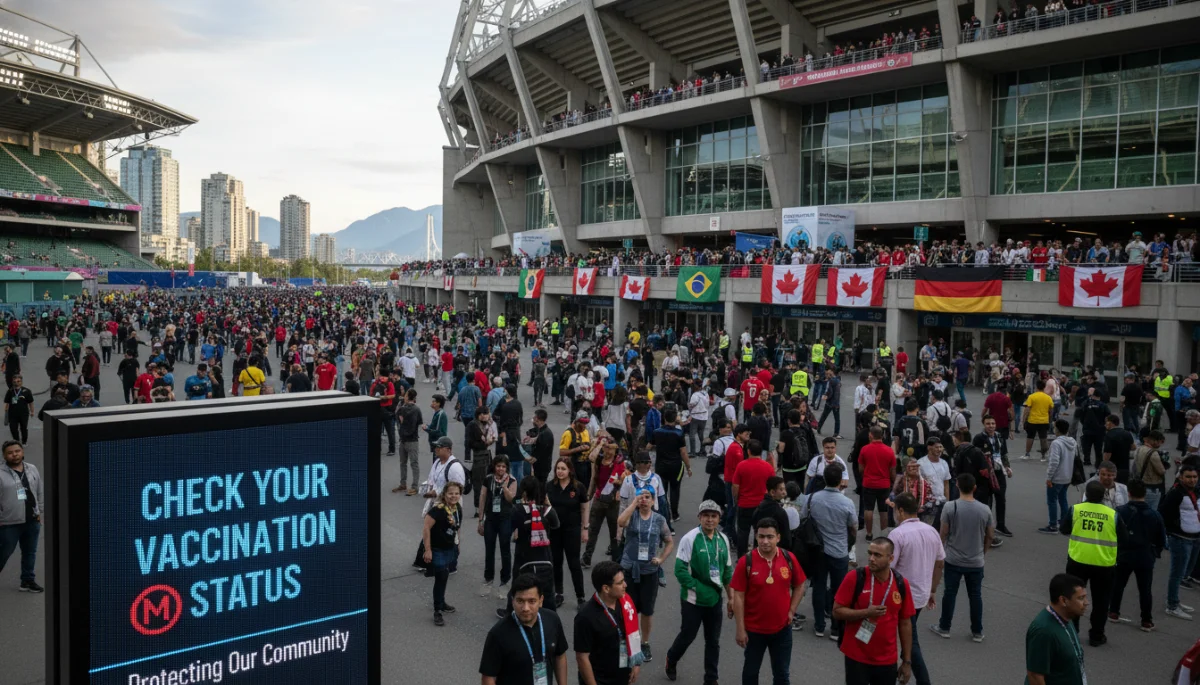
Health officials in Canada are watching closely as the FIFA World Cup approaches Vancouver, because large international events can give infectious diseases a fast track into new communities. Measles is the main concern. It spreads through the air, it is highly contagious, and it can move quickly when people from many places gather in packed stadiums, transit hubs, hotels, and fan zones.
The Public Health Agency of Canada has already flagged measles as one of the illnesses most likely to be brought into the country during the tournament. That warning reflects a simple reality: measles is still active in many regions around the world, and one imported case can become a much bigger problem if vaccination coverage is weak in the places it lands.
Why health experts are uneasy
Public health leaders say the risk is not about one game or one crowd. It is about the combination of travel, density, and uneven immunity. Ontario has published a detailed infectious disease assessment for the event, and its analysis points to several pressure points at once:
- heavy international travel before and during the tournament
- large crowds in close indoor and outdoor spaces
- lower vaccination rates in some communities
- the ease with which measles can spread through the air
British Columbia has not yet released its own public assessment, which has prompted some experts to call for clearer messaging before fans begin arriving in larger numbers.
What local doctors want residents to do
Dr. Brian Conway of the Vancouver Infectious Diseases Centre says the public conversation in B.C. should be more direct. In his view, residents and visitors should be reminded now, before the city gets busier, to check their vaccination records and make sure they are protected.
He also argues that people coming to Vancouver should know there is active measles transmission in Canada. That message matters because many travelers may assume the disease has already faded from everyday concern. In reality, the current outbreak has shown how quickly imported cases can keep showing up when exposure continues across borders.
Conway’s basic point is straightforward: if a city knows it is about to host a global event, it should prepare the public before the first wave of visitors arrives.
The numbers behind the current outbreak
Measles has not been a small, isolated issue in Canada this year. More than 900 cases have already been reported across seven jurisdictions, with Alberta and Manitoba seeing the largest share of infections.
That follows a much larger surge last year, when more than 5,000 people were infected nationwide. Officials believe that outbreak began with a case in New Brunswick in fall 2024 after the patient was exposed outside Canada.
| Region or period | Reported measles activity | Why it matters |
|---|---|---|
| Canada in the current year | More than 900 cases | Shows ongoing national transmission risk |
| Canada last year | More than 5,000 cases | Demonstrates how quickly outbreaks can grow |
| British Columbia in 2025 and 2026 | 470 reported cases | Highlights continued provincial exposure |
| Northeastern B.C. | About 80 percent of B.C. cases | Suggests concentrated vulnerability in lower-immunity areas |
In British Columbia, the pattern is especially uneven. Provincial data show that about 80 percent of reported cases have been clustered in northeastern B.C., where immunization rates are among the lowest in the province.
Why Vancouver still feels the pressure
There is reason to think Vancouver can manage the risk, but not reason to ignore it. Vancouver Coastal Health says it has been preparing for the World Cup for years and has completed a public health risk assessment with the B.C. Centre for Disease Control. The full findings have not been released, but Deputy Chief Medical Health Officer Dr. Mark Lysyshyn says measles was rated at a medium, or moderate, level of concern during the event.
He notes that the health authority has already handled dozens of imported measles cases during the current outbreak. Importantly, those cases have not led to sustained spread in the region. Lysyshyn credits strong immunization coverage in the Vancouver Coastal Health area for helping stop the virus from moving further.
That does not mean the city can relax. It means the system is better prepared than it might otherwise be. If a case appears during the tournament, public health teams will need to move quickly with tracing, testing, and follow-up.
Lessons from past sporting events
Experts also point to Vancouver’s own history. After the 2010 Winter Olympics, British Columbia saw a measles outbreak that produced 82 confirmed cases. The situation is not identical to a World Cup, but the lesson is familiar: major sporting events bring together large numbers of people who have traveled from many different places, and that creates openings for contagious diseases.
Dr. Conway says the current risk may be higher than it was in the past because vaccination rates have declined in some parts of the province. He also notes that some countries sending teams, staff, and supporters may have even lower coverage, which increases the odds that an infected traveler could arrive during the tournament.
Where the greatest risk lies
Dr. Monika Naus of the University of British Columbia’s School of Population and Public Health says the public should keep the risk in perspective. Large gatherings always bring some chance of disease spread, but most adults are already immune to measles through vaccination or previous infection, so the danger to the general public is limited.
The real concern, she says, is what happens if measles reaches communities where vaccination rates are low. Those communities are more likely to experience local spread, especially when they are already geographically clustered and have less protection overall.
- Most vaccinated adults face little personal risk
- Unvaccinated children and adults are more vulnerable
- Clustered low-immunity communities can support outbreaks
- Imported cases are most dangerous when follow-up is delayed
Why vaccination checks matter now
Canada lost its measles elimination status after the Pan American Health Organization determined that transmission was no longer limited to isolated imported cases. A country can regain that status if transmission is interrupted for a full year, but that requires sustained control and strong immunization.
That is why officials keep returning to the same advice before the World Cup: check your vaccination status. For residents, that means reviewing immunization records well before crowds arrive. For visitors, it means understanding that measles is not just a distant global issue; it is a real risk in places where the virus is actively circulating.
In the end, the challenge for Vancouver is balancing celebration and caution. The city is preparing to host a major international event, but public health leaders want to make sure that excitement does not create avoidable openings for a disease that is both serious and preventable.