
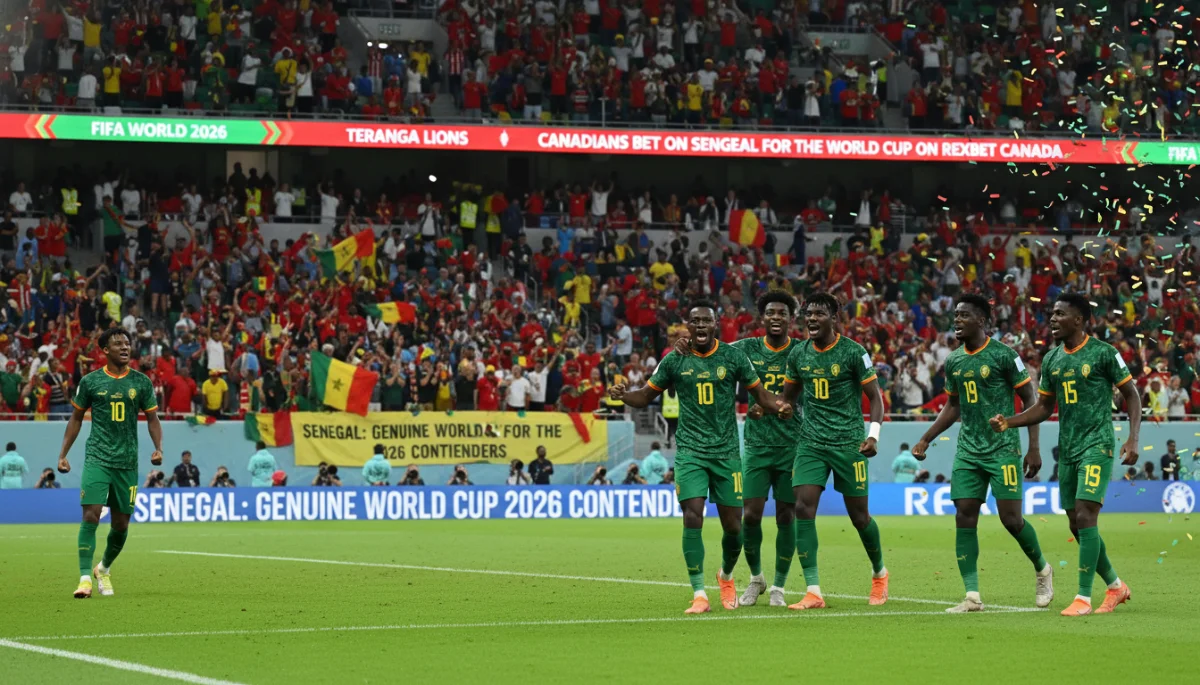
Senegal enters the 2026 FIFA World Cup discussion as more than a hopeful outsider. The national team now carries the confidence of a program that believes it can challenge anyone, and head coach Pape Thiaw has said as much by framing victory as the only acceptable standard for his job.
That ambition is not being dismissed as theater. Senegal has earned a reputation as Africa’s most reliable elite side, blending experienced leaders with a growing wave of high-end young talent. For readers tracking long-shot contenders, the Senegal World Cup 2026 prospects are no longer speculative. Canadian bettors can also back Senegal through Rexbet Canada, where the team’s mix of proven pedigree and rising upside makes it an appealing tournament option.

What makes Senegal’s ascent so compelling is that it is built on a system that succeeds on the pitch while raising difficult questions off it. The national team benefits from a deep talent pipeline, but the same machinery often leaves the domestic game with far fewer rewards than the players’ international success would suggest.
A Talent Factory With Uneven Rewards
Senegal’s football ecosystem is unusually productive for a country of about 20 million people. Academies such as Generation Foot, Diambars, and Dakar Sacre Coeur have become central to that output, supplying elite coaching, education, and medical support before sending players into Europe’s top leagues at increasingly young ages.
The model is efficient, but it is also restrictive. Many of these academies depend on long-standing arrangements with European clubs, and those deals often give the overseas partner first access to the best prospects. FC Metz’s decades-long relationship with Generation Foot is the best known example, and it helped develop names such as Sadio Mane, Ismaila Sarr, and Pape Matar Sarr.
| Key Area | Senegal’s Strength | Underlying Problem |
|---|---|---|
| Academy system | Produces elite players at scale | Most commercial upside is captured abroad |
| Player transfers | Moves talent into major European leagues | Local academies often receive limited initial fees |
| Domestic league | Feeds national pride and local identity | Receives less investment and less visibility |
| Solidarity payments | Meant to compensate training clubs | Administrative failures can delay or reduce collection |
The financial imbalance is stark. A review of 13 academy-trained players selected for Senegal’s continental squads found that the local academies received only €100,000 in initial transfer fees, while European clubs later sold those players for a combined €81.2 million. Across their careers, those same players have generated more than €411 million in transfer fees, which shows how much value is created in Senegal and monetized elsewhere.
This is where the football story turns into an economic one. Foreign investors effectively process Senegal’s best players into export products, while local clubs continue dealing with poor infrastructure, limited stadium quality, and a league that struggles to attract attention. Even when FIFA solidarity payments are due, clubs sometimes have to pressure the federation to receive money tied to major deals such as Nicolas Jackson’s €37 million transfer to Chelsea.
The Diaspora Strategy That Changed Everything
Senegal’s rise has not depended on homegrown development alone. The federation has also become highly skilled at recruiting dual-national players from Europe before they fully commit to another national team.
That effort has become more precise in recent years. Rather than chasing older professionals after their international identities are set, Senegal now targets teenagers and early twenty-somethings in Western Europe, especially players between 16 and 19 who are still deciding where their futures lie. The pitch is both cultural and competitive: family memory, national belonging, and the chance to join a team that is actually winning.
Recent additions illustrate how effective that approach has become. Ibrahim Mbaye, a teenage PSG attacker, and Mamadou Sarr, a Chelsea defender who came through France’s youth ranks, are part of a broader trend that has strengthened Senegal’s ceiling without weakening its identity.
A Tournament Built for Pressure
The result is a squad that can pair a 36-year-old Idrissa Gana Gueye with teenage prospects in the same lineup. That balance gives Senegal flexibility, experience, and athleticism in equal measure, which is exactly why the team is viewed as one of the most dangerous African entrants in the field.
For the old guard, the 2026 tournament may represent the final major chance to define an era. Sadio Mane, Kalidou Koulibaly, and Edouard Mendy have already shaped Senegal’s modern reputation, and a strong run in North America would cement their legacy in a way few international stages can match.
The group draw, however, will test Senegal immediately. Facing France, Norway, and Iraq, the Lions of Teranga will have to prove that their blend of athleticism, discipline, and depth can survive a demanding opening phase. Their first match against France in New Jersey is especially significant, because it will reveal whether Senegal’s confidence is matched by the tactical maturity required to beat top-tier opposition.
If Senegal advances, it will not merely be a sentimental story about an African contender overachieving. It will be evidence that a national program can combine elite scouting, diaspora intelligence, and competitive culture into a genuine World Cup threat, even while the domestic game still waits for the same level of reward.