
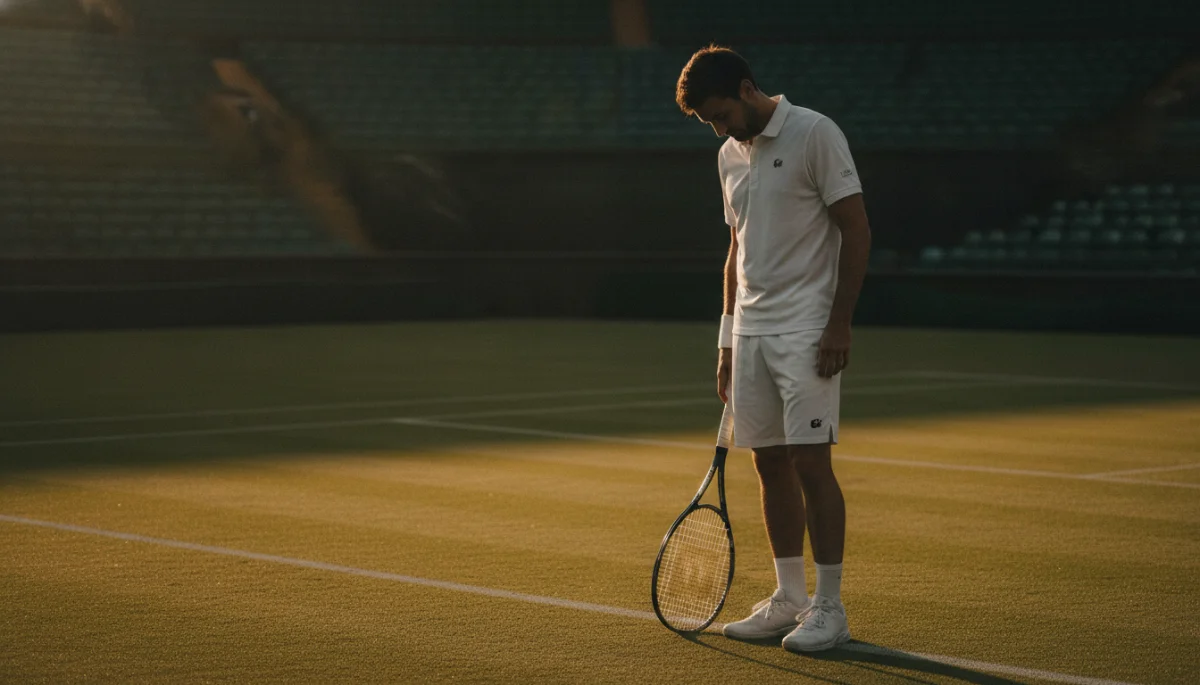
Nick Kyrgios has admitted he failed a drug test for cocaine, calling the outcome a sobering moment after years of disrupted form and repeated physical setbacks. The former Wimbledon finalist is now dealing with a provisional suspension and a major new test of his future in the sport.
A Career Still Searching for Stability
Kyrgios, 31, has spent much of the past two years battling injuries that have kept him away from consistent competition. Since his breakout 2022 run to the Wimbledon final, he has appeared in only 10 tour-level singles matches and has won just two of them.
His ranking has dropped sharply to No. 919, a reflection of how little he has been able to play. For a player once capable of beating the best on the biggest stages, the decline has been steep and unmistakable.
- Best recent major run: Wimbledon finalist in 2022
- Tour-level singles matches since then: 10
- Tour-level singles wins since then: 2
- Current ranking: No. 919
What Kyrgios Said Publicly
In a statement posted on Instagram, Kyrgios said he had tested positive for cocaine after a tournament in Mallorca, Spain. He accepted responsibility immediately and described the incident as a serious mistake rather than something he intended to excuse.
He also framed the episode as a personal turning point, saying the situation had forced him to confront how difficult the last few years have been. In his words, the setback has served as a wake-up call that may help him reset both mentally and professionally.
“I recently failed a drug test in Mallorca after testing positive for cocaine,” Kyrgios wrote. “I made a huge mistake and take full responsibility for it.”
“However, the good news is that this has given me a wake up call,” he added, before saying he would step away from social media and public life for 28 days.
How the Anti-Doping Case Works
The International Tennis Integrity Agency is handling the matter, and the timeline has already been outlined. Kyrgios’s sample was taken on June 22, the positive result was confirmed on July 17, and a mandatory provisional suspension began on August 4.
He did not appeal that suspension, according to the ITIA. Under anti-doping rules, cocaine is treated as a prohibited in-competition substance, which means the final sanction could depend heavily on the details surrounding use and timing.
A ban of up to four years is possible in theory, but a far lighter penalty is often more realistic in cases where the substance use is not tied directly to competition.
- Sample date: June 22
- Positive result confirmed: July 17
- Provisional suspension began: August 4
- Appeal filed: No
Why the Timing Matters
The result came after Kyrgios had already played at Wimbledon, which adds another layer of complication to the case. Even so, the substance was not flagged as part of a match-day incident, and that distinction may influence the eventual ruling.
There is also precedent for shorter punishment in comparable situations. British player Dan Evans received a one-year ban from the International Tennis Federation in 2017 after a positive cocaine test at the Barcelona Open, a case often cited when discussing proportional penalties.
The Broader Picture Around His Decline
Kyrgios’s recent tennis record has been shaped less by results than by absence. A knee injury suffered in Tokyo in October 2022 began a long interruption, and a wrist problem later ruled him out of Wimbledon in 2023.
His 2025 season was also underwhelming, starting with a first-round exit at the Australian Open before he skipped the next three Grand Slam events. This year has been little better, with one win and three losses in singles play.
He did make one recent appearance at Wimbledon in doubles, teaming with Alexander Bublik through a wild card entry, but that partnership ended in the opening round.
What Comes Next
For now, the immediate story is not just about punishment but about whether Kyrgios can rebuild enough momentum to continue at all. His statement suggests he still sees a future in the sport, even if the path back is now more complicated.
He has been one of tennis’s most watchable and unpredictable figures for years, but this latest episode turns attention away from talent and toward accountability. The next stage will depend on the anti-doping process, his physical recovery, and whether he can turn this setback into something more lasting than regret.