
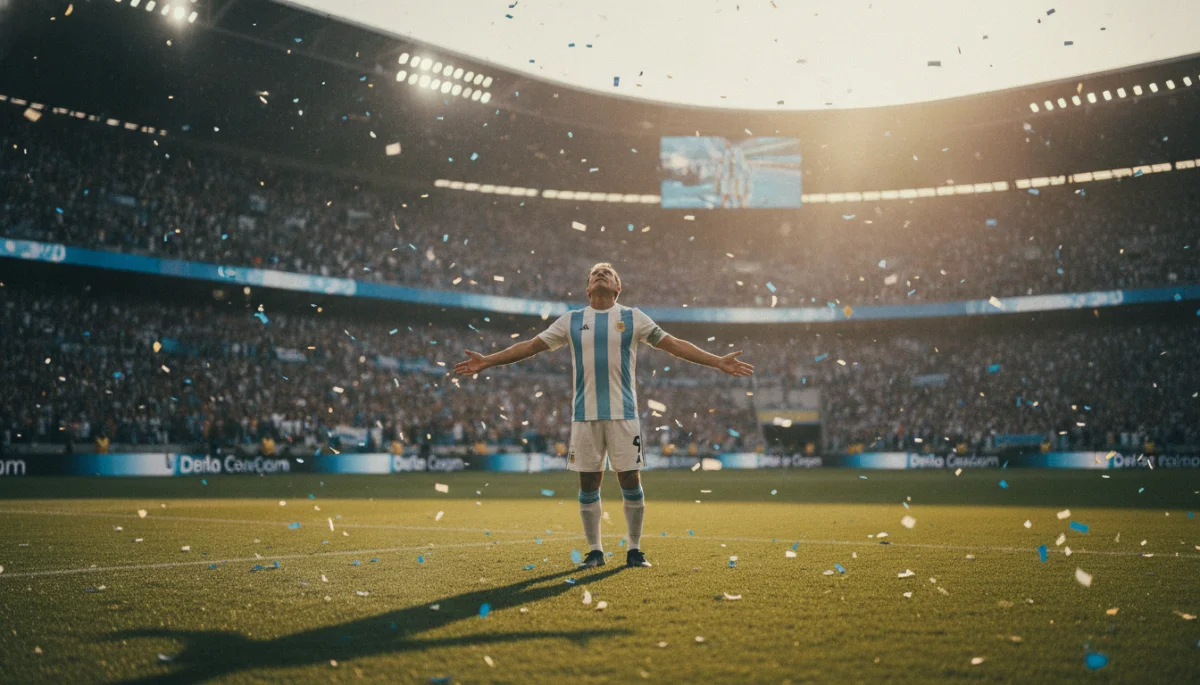
Sport has moments where stats become stories, and numbers turn into poetry. Lionel Messi reached that moment last Monday in Arlington, Texas. The world watched, stunned, as the 38-year-old Argentine made history once again.
In the 38th minute against Austria, Messi curled a perfect left-foot shot into the net, breaking the scoreless tie. Minutes earlier, he missed a rare penalty—a stumble for such a legendary finisher—but he didn’t let it shake him. He bounced back and scored the goal that would define his legacy. Just before the final whistle, he added another scrappy, determined rebound goal in stoppage time. With those two strikes, Messi now owns 18 career FIFA World Cup goals, surpassing Germany’s Miroslav Klose, Brazil’s Marta, and every other player in men’s or women’s history. He is the all-time leading scorer in World Cup history, male or female.
At 38, most athletes are nearing retirement. Messi is rewriting the record books while playing some of his best soccer of his life.
From Hat-Trick to Record Stand
Messi’s record-breaking journey began before the tournament’s first full viewing weekend. On June 16, in Argentina’s opener against Algeria, he scored his first-ever World Cup hat-trick. That trio of goals tied Miroslav Klose’s long-standing record of 16 World Cup goals. At 38 years and 357 days, Messi became the oldest player ever to score a World Cup hat-trick, edging past Cristiano Ronaldo, who was 33 when he scored three against Spain in 2018.
Six days later, against Austria, he did it again. Entering the match with 16 goals, Messi initially missed a penalty in the ninth minute, briefly delaying his record. But the miss only made what came next more dramatic. He curled home from a cutback in the 38th minute and added a second in stoppage time, finishing with two goals in a 2-0 win. His total moved to 18. Five goals in two matches. Eighteen across six World Cups. The record is his.
What His Numbers Truly Show
To grasp the scale of Messi’s achievement, consider the career behind it. He scored his first World Cup goal on June 16, 2006, at age 18, against Serbia and Montenegro. Twenty years later, he continues to break records, becoming the first player to appear in six different editions of a men’s World Cup.
Messi is also the second man in history to score four or more goals in three different World Cups, after Klose (2002, 2006, 2010). Remarkably, he has joined Roger Milla as the only men to score four or more goals in a single World Cup at age 38 or older.
His teammates have run out of words to describe his impact. After the Austria win, midfielder Alexis Mac Allister said, “If anyone thought this group was better off without Leo, today it became clear that Leo is the most important of them all.”
The Mbappé Challenge Looms
Messi’s record may not be safe for long. Kylian Mbappé now has 16 career World Cup goals, sitting second all-time behind Messi’s 18. The French captain is still in this tournament, and with France looking like genuine contenders, the gap could narrow quickly.
But for now, Messi leads. The question is how many more he can add before his final World Cup ends. His teammates continue to rally around him, knowing they are part of a team built to win.
If Canada navigates the round of 32 and beyond, Messi and Argentina could be waiting. Understanding what they face—a 38-year-old playing at his peak, surrounded by world-class talent—is essential. Argentina has won all their group matches, conceded zero goals, and looks like the team to beat.
Watch Argentina vs. Jordan tonight at 10 p.m. ET on TSN. Messi will almost certainly be on the pitch. If recent form is any guide, history may be made again.