
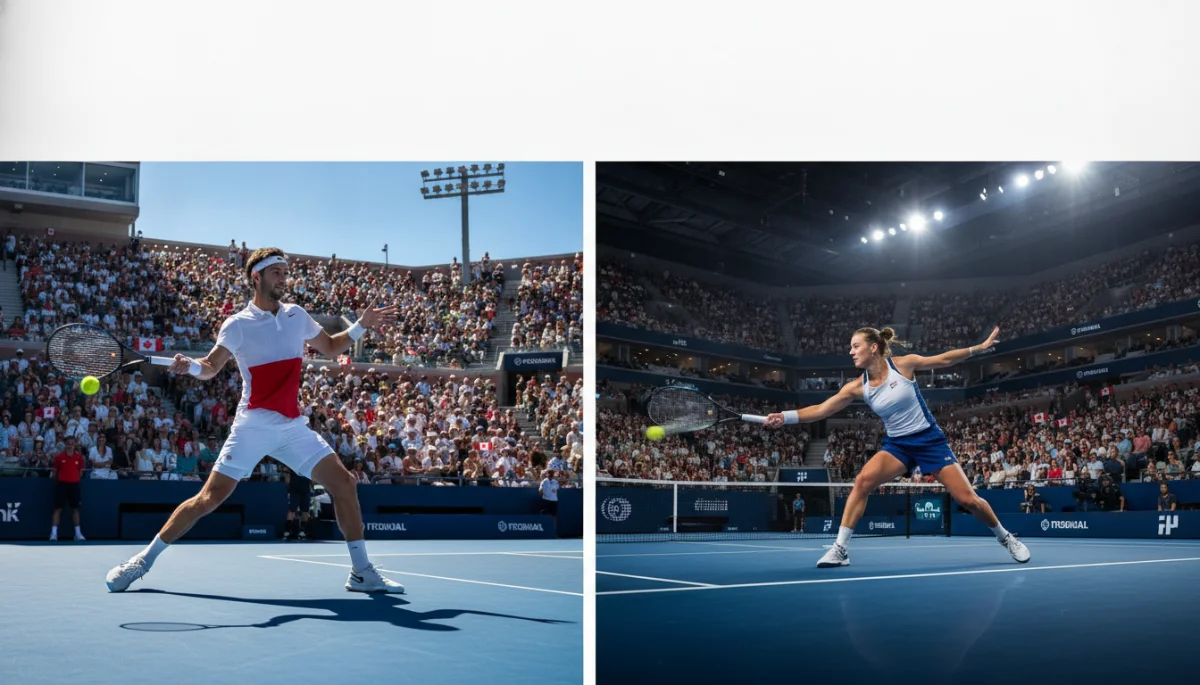
The National Bank Open reaches a key turning point this weekend as the round of 16 takes over Montreal and Toronto. By Sunday night, the draw will be cut in half, and the paths to the title will look much clearer in both cities.
Montreal has already delivered major chaos on the men’s side, while Toronto has kept many of the biggest women’s names on track. That contrast makes the next two days especially important, with Canadian interest also centered on Leylah Fernandez as she carries the home crowd’s last hope.
Weekend Schedule and Session Times
The round-of-16 matches are set for Saturday, August 8, and Sunday, August 9, 2026. Each city will host four singles matches per day, with the winners advancing to the quarterfinals early next week.
In Montreal, play at IGA Stadium will open with the day session at 12:30 p.m. and continue with an evening session at 6 p.m. Toronto will use the same daytime start, while the night session there begins at 7 p.m..
The exact order of play is usually released the day before each session, since match length, court usage, and weather can all affect scheduling.
- Montreal: day session at 12:30 p.m., evening session at 6 p.m.
- Toronto: day session at 12:30 p.m., evening session at 7 p.m.
- Dates: August 8 and August 9, 2026
- Reward: a place in the quarterfinals
Montreal’s Men’s Draw Has Completely Shifted
The men’s competition in Montreal has become one of the most unpredictable parts of the tournament. Several top seeds left early, and that has created an opening for players who would normally face a much harder route.
Alexander Zverev, Daniil Medvedev, Taylor Fritz, and Andrey Rublev all fell in their first matches. Félix Auger-Aliassime, the second seed and one of the main local favorites, withdrew because of a back injury. By the end of the second round, six of the top 10 seeds were already out.
That kind of turnover changes the entire shape of the event. Instead of a draw led by the usual heavy favorites, Montreal now looks wide open and far more volatile.
| Player | Opening Result | What It Means |
|---|---|---|
| Ben Shelton | Beat Jenson Brooksby 6-3, 7-5 | Still the leading name in the bottom half |
| Casper Ruud | Beat Juan Manuel Cerúndolo 6-1, 6-2 | Strong early form on a hard court |
| Tallon Griekspoor | Beat Alexander Zverev 6-7, 6-2, 6-4 | One of the biggest surprise winners so far |
| João Fonseca | Beat Stefanos Tsitsipas | Young threat with major upside |
| Arthur Fils | Beat Zachary Svajda in three sets | Built for long, athletic matches |
Ben Shelton Still Sets the Pace
Ben Shelton remains the most obvious favorite left in the men’s field. The defending champion opened with a straight-sets win over Jenson Brooksby and looked comfortable doing damage with his serve and first strike tennis.
His style suits the fast conditions in Montreal. When Shelton is landing his first serve and finishing points quickly, he can make even experienced opponents feel rushed.
This year, though, his challenge is different. He is no longer the underdog trying to surprise the field; he is the player many expect to manage a deep run. That shift in expectation can matter in a draw that has already removed several proven names.
His most important task is staying disciplined. If he gets too eager to end points early, he can drift into stretches of inconsistency. Against stronger returners, that window could become dangerous.
Young Contenders See an Opening
The bracket may be even more favorable for players on the rise. With so many seeds gone, a new wave of talent has a realistic chance to push into the later rounds.
- João Fonseca announced himself by knocking out Stefanos Tsitsipas in a hard-fought match.
- Arthur Fils showed his athletic range in a three-set win over Zachary Svajda.
- Tallon Griekspoor followed his comeback against Zverev with a confidence boost that could carry forward.
- Casper Ruud has the experience to take advantage if the draw continues to thin out.
Fonseca in particular has the kind of power that can turn a match quickly, and he has already shown he is comfortable on a big stage. Fils, meanwhile, brings movement and patience, which can be a major advantage in a draw full of pressure. Griekspoor’s upset over Zverev gives him the belief that he belongs in this company.
Canada’s Men Endure a Rough Start
For the home crowd, the men’s side has been disappointing. Auger-Aliassime’s withdrawal removed the highest-profile Canadian contender before he could even step on court. Gabriel Diallo did give local fans something to celebrate when he beat Kyrian Jacquet for his first main-draw victory in Montreal, but that run ended quickly.
Diallo retired against Luciano Darderi after trailing 6-4, 2-3, leaving Montreal without a Canadian man in the round of 16. That outcome stings for a tournament that usually leans on local interest to build energy through the week.
Even so, the crowd still has plenty of recognizable names to follow, especially in Shelton, Ruud, Fonseca, Fils, and Griekspoor.
Toronto’s Women’s Field Keeps Its Stars Alive
The women’s event in Toronto has been steadier. The biggest names have largely held serve, and the round of 16 now features several players who look capable of winning the whole tournament.
Aryna Sabalenka, Elena Rybakina, Jessica Pegula, Coco Gauff, and Mirra Andreeva all advanced through their opening matches. That group gives the tournament a much more familiar shape than the men’s draw in Montreal.
Sabalenka remains the player everyone is chasing. She opened with a 6-3, 6-3 win over Moyuka Uchijima and extended her hard-court winning streak to 13 matches. On Toronto’s quicker courts, her serve and pace off both wings are especially effective.
The Main Threats in the Women’s Draw
Rybakina, Pegula, Gauff, and Andreeva each bring a different style, but all four remain serious contenders.
- Elena Rybakina needed three sets to get past Daria Kasatkina, showing both her ceiling and her error risk.
- Jessica Pegula recovered from a first-set loss against Magdalena Frech and finished strong.
- Coco Gauff used speed and defense to outlast qualifier Kayla Day.
- Mirra Andreeva delivered the cleanest win of the group, beating Karolina Pliskova 6-0, 6-2 in 54 minutes.
Rybakina’s numbers from her opening match tell the story well: 58 winners and 58 unforced errors. That is the kind of line that can overwhelm some opponents and frustrate others. If she sharpens the margin, she becomes even more dangerous.
Pegula’s success in Canada should also not be overlooked. She has won this tournament twice, and those title runs have given her a strong feel for North American summer conditions.
Gauff does not need total control of rallies to win, because her movement can turn defense into offense fast. Andreeva, at just 19, already plays with unusual calm and variety, and her quick adjustment to hard courts is a warning sign for the rest of the field.
Leylah Fernandez Keeps the Home Crowd Engaged
Leylah Fernandez is now the last Canadian still standing in singles. She moved into the round of 32 with a composed 6-2, 6-2 victory over Renata Zarazúa, and the crowd response reflected how much her run matters to the tournament atmosphere.
Fernandez dropped serve only once and broke her opponent five times, which made the match look much more controlled than many expected. Her next test comes against Elise Mertens, a smart and steady opponent who can stretch points and force errors.
To keep advancing, Fernandez will likely need to stay aggressive. When she takes the ball early and uses her forehand to open the court, she can match up well with higher-ranked players. The challenge is doing that consistently under home pressure.
That pressure is real, but it also gives her an opportunity. With the rest of the Canadian singles field already gone, her matches carry extra weight for local fans.
What to Expect From the Final Weekend Bracket
The round of 16 should reveal whether Montreal’s men’s draw remains chaotic or settles into a more predictable shape. Shelton and Ruud bring the most established profiles, but Fonseca, Fils, and Griekspoor have already proven they can disrupt higher-ranked opponents.
Toronto feels more stable, but that does not mean it is settled. Sabalenka has the clearest form line, Rybakina has the highest volatility, and Pegula, Gauff, and Andreeva all have the tools to make a run.
For viewers in Canada, the most emotional storyline is Fernandez. If she survives another round, the tournament will still have a local figure to rally around as the quarterfinals approach.
Sportsnet and TVA Sports are the official Canadian broadcasters for the event, with coverage available across their television and digital platforms. The next two days will determine who is still alive when the tournament moves into its decisive final stages.