
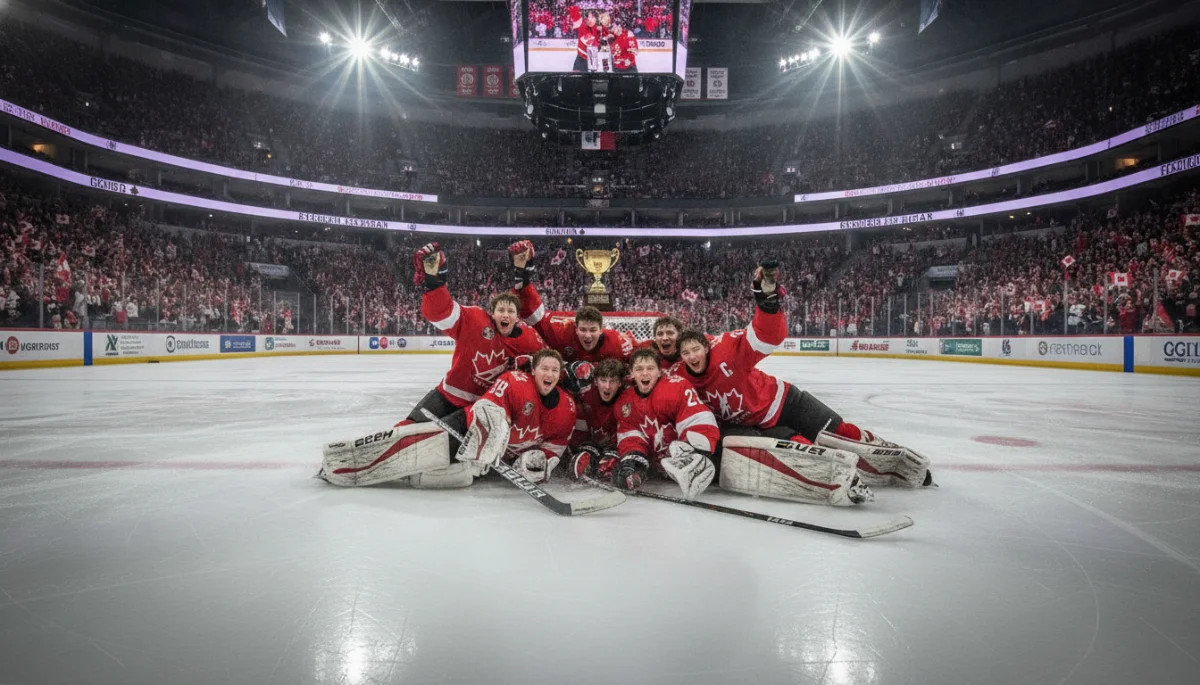
Canada has moved within one win of the 2026 Hlinka Gretzky Cup championship game after sweeping its preliminary schedule in Edmonton. The host nation now turns its attention to Finland, a semifinal opponent that has already shown resilience and composure in the tournament.
The matchup comes Friday, August 7, at Rogers Place, and the stakes are simple: win and advance to Saturday’s gold medal game, or lose and shift to the bronze medal contest. Canada has looked like one of the most complete teams in the event so far, combining scoring depth, pace, and a strong first-round record.
The semifinal matchup and start times
Canada meets Finland in the semifinal on Friday, August 7, 2026. The game will be played at Rogers Place in Edmonton, where the Canadians have already delivered three convincing results in front of the home crowd.
- 5 p.m. Mountain Time
- 7 p.m. Eastern Time
- 4 p.m. Pacific Time
- 8 p.m. Atlantic Time
- 8:30 p.m. Newfoundland Time
The winner moves directly into the championship game. The team that falls short will play for bronze later in the tournament.
The other semifinal features the United States and Slovakia earlier on Friday, which means Canada already knows its possible final opponent. That creates a clear tournament picture heading into the knockout round.
How Canada earned the top seed
Canada did not simply advance. It dominated Group A with three straight wins and a total of 20 goals across the preliminary round. That output reflects a roster with multiple scoring threats rather than a team depending on one line or one star.
The Canadians opened with a 7-3 win over Switzerland, then followed it with a 6-1 result against Slovakia, and closed the round by defeating Sweden 7-4. Each game showed a different side of their attack, from early pressure to finishing ability and late-game resilience.
The most eye-catching performance may have been the Sweden game. Canada jumped out to a five-goal lead in the first period, then answered every pushback with another wave of offense. The hosts finished with 49 shots, a sign of how often they controlled possession and pushed play into the offensive zone.
| Team | Record | Goals For | Goals Against | Group Finish |
|---|---|---|---|---|
| Canada | 3-0-0 | 20 | 8 | First in Group A |
| Finland | 2-1-0 | 11 | 10 | Second in Group B |
| United States | 3-0-0 | 18 | 6 | First in Group B |
| Slovakia | 2-1-0 | 12 | 7 | Second in Group A |
That table tells the story of the semifinal bracket. Canada reached the knockout stage with the best offensive numbers in Group A, while Finland advanced with enough grit to make the matchup competitive.
What Canada might face in the title game
If Canada gets past Finland, the gold medal game will bring either the United States or Slovakia to the ice on Saturday, August 8. Both possibilities create different storylines, but each would be meaningful in its own way.
A meeting with the United States would bring together two undefeated teams. The Americans won all three of their preliminary games, beating Czechia, Finland, and Germany while allowing only six goals. They also entered the semifinals as the defending champion after winning the 2025 Hlinka Gretzky Cup.
A matchup with Slovakia would create a rematch of Tuesday’s group-stage game, which Canada won 6-1. Kayden Stroeder scored twice in that victory, and Canada’s speed through the middle of the ice caused problems throughout the night.
Slovakia still has one major weapon in forward Tomas Selic, who led all players after the preliminary round with eight points. He posted five goals and three assists, which means Canada cannot treat a second meeting as a routine assignment.
Canada’s key players heading into the semifinal
Canada’s best advantage has been its spread-out offense. The team has received production from forwards and defensemen, and that balance has made it difficult for opponents to key on one target.
- Maddox Schultz has been Canada’s top point producer with one goal and six assists.
- Liam Pue leads the team in goals after scoring four times and adding two assists.
- Kayden Stroeder has delivered three goals and three assists, including a strong outing against Slovakia and a productive night against Sweden.
- Landon DuPont has provided one goal and two assists while helping drive puck movement from the back end.
- Leif Oaten has handled the goaltending load and will likely be asked for timely saves if the semifinal tightens.
Schultz has been especially valuable because he creates offense for others. His passing has helped Canada stay unpredictable, and that kind of playmaking matters in a tournament where opponents have little time to adjust.
Pue has given Canada a different kind of danger. He finishes chances quickly and has already shown that he can score in bunches. Against a Finnish team that may give up stretches of puck control, efficient finishing could decide the game.
Stroeder has also been a stabilizing force. His ability to contribute in several situations gives Canada another reliable option when its top line is on the bench. DuPont, meanwhile, has helped the Canadians move the puck cleanly and keep pressure on in transition.
Why Finland can still make this difficult
Finland may not have Canada’s depth, but it has enough structure to make the semifinal competitive. The Finns opened with a comeback win over Germany, then lost to the United States before edging Czechia 5-4 in their final group game.
That final win mattered because it showed Finland could survive pressure and still produce when the margin was thin. In a short tournament, that kind of experience is useful.
Goaltender Samu Heikkinen is the most important Finnish player to monitor. He stopped 38 shots against Czechia and entered the semifinals with a .922 save percentage, which ranked among the best in the tournament after the preliminary round.
Canada is likely to spend more time in the attacking zone, but Finland can punish sloppy passes and loose puck management. If the Canadians force the pace without control, they could feed the kind of counterattack opportunities the Finns want.
That is why the semifinal may depend on patience as much as skill. Canada should expect to generate volume, but it also needs to create traffic, second chances, and rebounds rather than settling for low-percentage shots from the perimeter.
What Canada must do to finish the job
Canada’s biggest task is to stay disciplined. The Sweden game showed how quickly a comfortable lead can lose shape when penalties begin to pile up.
The Canadians also need cleaner decisions through the neutral zone. Finland is comfortable waiting for mistakes and using quick transitions to turn defense into offense. A careless turnover could change the mood of the game quickly.
There is also the matter of composure after missed chances. Finland’s goaltending gives it a chance to hang around, so Canada cannot become rushed if the puck does not go in early. A patient approach will matter more than constant pressure without structure.
If Canada keeps its pace, protects the puck, and avoids unnecessary penalties, it has a strong chance to reach the gold medal game. If it loses discipline, the semifinal could become far more dangerous than the standings suggest.
A chance at another Canadian summer title
Canada entered the tournament chasing its record-setting 26th summer under-18 gold medal. The country has already won 25 of the 34 gold medals awarded since the event began in 1991, and it remains the most successful program in tournament history.
The group stage showed why Canada is again in the conversation. It has scoring from multiple lines, active defensemen, and enough speed to pressure opponents from the opening puck drop. Playing at home only strengthens that profile.
The next step is straightforward. Beat Finland, and Canada gets one more chance to play for gold in Edmonton.